OKX Wallet, Sign-In, and Spot Trading: Separating myths from mechanics
Surprising statistic to start: more than 95% of assets held by OKX are kept in offline cold storage. That number is often quoted as if it settles the security question for users—and it doesn’t. The truth is more layered: cold storage reduces certain systemic hacking risks, but it does not eliminate everyday attack vectors that affect individual traders. This piece unpacks how OKX’s wallet and login systems work, what spot trading on the platform really affords U.S.-based traders, and which persistent misconceptions matter when you decide where and how to hold and trade crypto.
The goal is practical: give you a working mental model of OKX’s custody choices, the mechanics of signing in, and the trade-offs you accept when you use OKX for spot or margin trades. We will correct common myths, explain where the platform’s protections are strongest and weakest, and provide decision-useful heuristics you can apply before you click “deposit” or attempt a leveraged spot trade.
How OKX stores and protects assets — mechanism, limits, and what it means for you
Mechanism first: OKX combines centralized custody for exchange balances with a non-custodial Web3 wallet option. The exchange side keeps the lion’s share—over 95%—in air-gapped, multi-signature cold wallets, which reduces the attack surface for mass-extraction hacks. That’s complemented by Proof of Reserves (PoR) transparency, which lets users verify on-chain that the exchange maintains backing for deposited assets.
Where that strong-sounding setup breaks down for individuals is in attack vectors that bypass cold storage entirely: phishing sites, compromised passwords, SIM-swaps, or social-engineering assaults that hand over credentials. OKX accounts specifically add layers—mandatory KYC, two-factor authentication (2FA) via SMS, Google Authenticator, or biometrics, and AI-driven login threat detection—but those mitigations are probabilistic, not absolute.
Trade-off to understand: a centralized exchange reduces the individual burden of key management (no single user losing a seed phrase), but it concentrates custodial risk inside an institution. A non-custodial OKX Web3 wallet hands control to you; you gain absolute custody but also absolute responsibility for seed phrase security and hardware wallet management. Neither approach is universally superior—choose based on your threat model.
Signing in to OKX: practical mechanics and common misconceptions
Signing in to OKX is not just typing an email and a password. Expect a staged process: account creation with KYC (ID + liveness check), setting up 2FA, and optionally linking a biometric-capable mobile app or a hardware wallet. For U.S. traders who value convenience, the mobile app offers biometric login—but remember biometric login is local convenience, not a substitute for 2FA tied to account recovery or withdrawal approvals.
If you need a quick path to the login page, use the official link provided by OKX or the exchange’s verified mobile app. A practical help: bookmark trusted entry points and avoid links in unsolicited messages. For an explicit, simple entrance to OKX web login resources, see this guide on how to okx sign in—it’s useful for orienting account setup and recovery steps.
Myth correction: “Strong exchange security means I can reuse weak passwords or ignore phishing.” False. Strong institutional security reduces the chance of catastrophic platform-level loss, but most individual account compromises arise from credential reuse, phishing, or poor device hygiene. Real practice: use a unique, strong password per account, hardware 2FA where possible, and validate domain names before submitting credentials.
Spot trading mechanics on OKX — what the platform offers and where it surprises
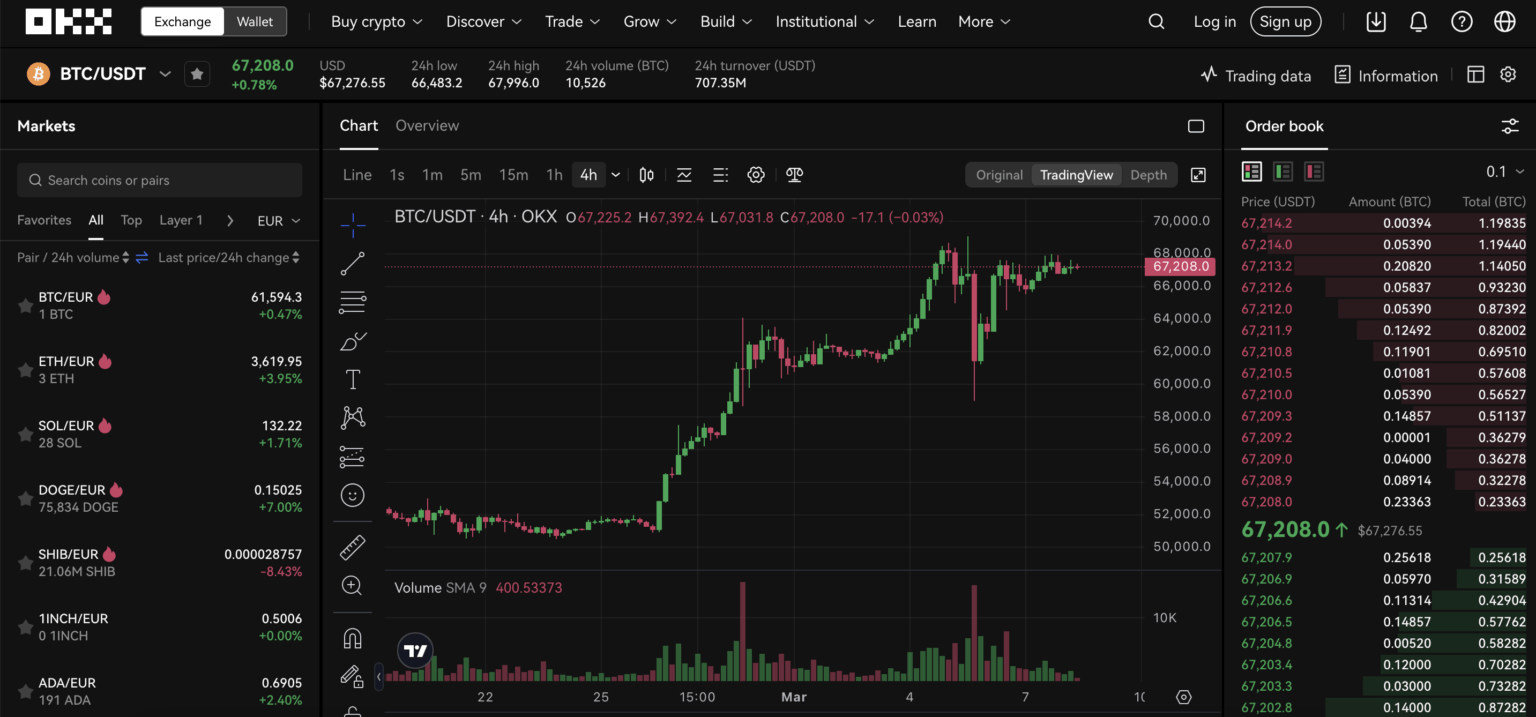
On the mechanics side, OKX offers a full-featured spot market with TradingView charting, limit/market orders, and advanced order types. Traders can also choose margin spot trades using isolated or cross-margin with up to 10x leverage—a critical distinction from futures where leverage can go much higher. Spot trading means you take delivery of the asset at the transaction price; margin spot borrows to increase position size but still settles on spot markets.
Non-obvious distinction: leverage modes change how liquidation cascades behave. In isolated margin, only that position’s collateral is at risk. In cross-margin, your entire margin balance can be eaten during market stress. For U.S. traders who sometimes experience higher slippage due to lower liquidity in certain altcoins, isolated margin limits collateral exposure and is often the safer default.
Common risk myth: “Spot trading is safe compared with derivatives.” Not necessarily. Spot eliminates funding-rate mechanics and can reduce complexity, but spot positions in low-liquidity tokens can suffer extreme slippage and wide bid-ask spreads during volatile moves. Always check order book depth, recent trade sizes, and slippage estimates before submitting sizable orders.
Practical heuristics and a decision framework
Here are decision-useful rules you can reuse:
- If you prioritize custody control and are comfortable with seed phrases/hardware wallets, use the non-custodial Web3 wallet and integrate a hardware device (Ledger/Trezor).
- If you want trading speed and on-exchange liquidity (staking, spot/ margin), use the CEX while minimizing stored balances: keep working capital on exchange, move long-term holdings to cold storage or your self-custodial wallet.
- Prefer isolated margin for speculative spot trades; reserve cross-margin for experienced portfolio-level strategies where you understand correlated liquidation risk.
- Before logging in from a new device, confirm the exact domain, enable 2FA, and avoid SMS 2FA if you are at high risk of SIM-swap—use an authenticator app or hardware 2FA instead.
Limitation to note: Proof of Reserves demonstrates on-chain backing of assets but does not prove every internal liability allocation or the timing of withdrawals. PoR increases transparency but is not a full audit of operational controls. Treat it as a stronger signal than none, but not an absolute guarantee.
What recent developments mean for U.S. traders
Recent headlines about major institutional investments into crypto platforms highlight two conditional implications. If regulatory channels and institutional capital continue to deepen, expect liquidity and product breadth to improve across exchanges. That can lower spreads and improve order execution for spot traders. Conversely, closer ties with legacy financial institutions can produce a stronger compliance stance (more KYC, stricter U.S. on-boarding) that improves regulatory predictability but may slow onboarding or limit certain products for U.S. residents.
Bottom line: growing institutional involvement is a signal to watch, not an automatic net-positive for every trader. For active U.S.-based traders, it likely means steadier infrastructure and more institutional-grade features; for privacy-oriented users it often brings more stringent identity checks and fewer anonymity-preserving options.
FAQ
Is OKX safe to hold large amounts of crypto long-term?
Short answer: it depends on your risk tolerance. OKX uses air-gapped cold storage and multi-signature withdrawals, which protects against many large-scale hacks. But “safe” for long-term holdings also depends on counterparty risk and your personal threat model. If you prioritize absolute control, self-custody with hardware wallets removes counterparty risk but shifts responsibility for secure seed management to you.
Can I use biometric login as my only security measure?
Biometrics are convenient and locally secure on your device, but they should complement—not replace—2FA and other account protections. Biometric login helps with quick access but doesn’t protect you from phishing sites or account recovery exploits. Pair biometrics with a strong password and an authenticator-based 2FA for better security hygiene.
What’s the difference between spot margin and futures on OKX?
Spot margin borrows to amplify a position in the underlying asset and typically uses up to 10x leverage on OKX; you still own the asset. Futures and derivatives (perpetuals, quarterly futures, options) are separate contracts whose prices derive from the underlying. Futures can offer much higher leverage—up to 125x on some products—and include additional mechanics like funding rates and maintenance margins that increase complexity and liquidation risk.
How should U.S. traders think about KYC and regulatory risk?
KYC is a compliance feature: it increases transparency and reduces certain illicit uses but also ties accounts to identity, which affects privacy. For U.S. traders, compliance generally means more predictable access to fiat rails and regulated product offerings, but it can also mean stricter limits or blockage of certain tokens depending on jurisdictional guidance. Factor in regulatory resilience as part of platform selection.
Parting framework: three questions to ask before you trade or store
Before you place an order or deposit funds on OKX, answer these quickly: 1) What is my custody preference for this asset—do I need instant trading access or am I cold-storing for years? 2) What is the realistic worst-case failure mode (account compromise, exchange insolvency, market flash crash) and how would it affect my position? 3) Which operational controls will I use to reduce that risk (hardware 2FA, isolated margin, hardware wallet, frequent withdrawals)?
These three questions convert abstract security and product characteristics into a concrete trade plan. They also force a discipline that separates marketing-speak from operable safeguards. Use them routinely; they’ll reveal whether a product’s surface features—like PoR, cold storage, or mobile biometrics—actually map to your risk tolerance and trading needs.